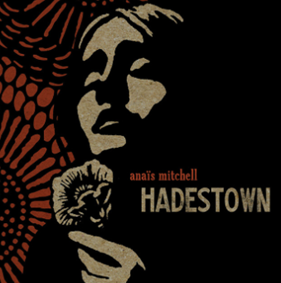

The Magic of musicals is a result of the combination of songs, acting, set design, costume design, dancing, and more. But sometimes, even the score alone is enough to leave a lasting impact. Hadestown has an amazing soundtrack, which won a Grammy for best musical theater album after its Broadway debut in 2019. The music of Hadestown tells two ancient stories at once by referencing several music genres and using the various tools of musical theater.
Hadestown tells two Greek myths: the story of Persephone and Hades, and the story of Orpheus and Eurydice. Hades, king of the underworld, abducts and marries Persephone, the goddess of spring. Persephone’s mother was not happy with this, so a deal was made that Persephone would spend one half of the year with Hades and the other half in the overworld. Orpheus and Eurydice are married mortals. Eurydice dies and goes to the underworld, so Orpheus makes a deal with Hades. Orpheus will walk from hell to earth, and Eurydice will follow him, but if he turns to see her, she has to go back. He fails, and Eurydice dies again. Hadestown retells Orpheus and Eurydice’s story after Hades and Persephone have been married for a while. Hades has become more and more possessive over Persephone, which unbalances the seasons. There are strong themes of class struggle and climate change. Hermes, the messenger of the gods, is the narrator.

Hadestown started as a community theater production in 2006. Four years later, Anais Mitchell, the creator of Hadestown, refined the music and released an album version of the musical. In 2013, she started to expand the album into a full-length production, and in 2016, it made its World Premiere. The fact that the music itself was refined on for arguably a decade shows the thought put into crafting this score.
The music style in Hadestown is a unique blend of several genres. Wikipedia describes the genres of the original non-Broadway album as, “encompass[ing] a variety of American roots music forms, including folk, indie folk, country, blues, ragtime, gospel, rock, swing, and avant-garde.” The genres are reflected in Hadestown through the way instruments are utilized and musical choices are made. The folk influence can be seen in the use of real, live instruments including trombone, piano, guitar, and more. These instruments are played on the same stage as the actors. The fact that the audience can see the musicians and instruments makes the music feel even more live and more realistically folk. Call and response is a common tool in blues music, and that is used in “Wedding Song” and “Our Lady of the Underground”. In “Wedding Song”, Eurydice asks Orpheus three questions about their potential marriage, with a similar refrain each time, and Orpheus responds with three musically similar answers. The chorus of “Our Lady of the Underground” includes Persephone asking, “brother, what’s my name?”, to which the ensemble responds, “our lady of the underground”. Jazz is the genre I most associate with Hadestown. The piano and the trombone, two prominent instruments in jazz music, are often the main instruments in a song. This is very apparent in “Our Lady of the Underground”, where there is a trombone solo. The style of music the trombone plays is also very similar to jazz music. In this song, Persephone introduces each instrument and musician, emphasizing the live and even improvised style of music that is often seen in jazz. The use of these specific genres indicates the setting of the story. These genres are much more modern than ancient Greece, so these styles shift the setting to a more modern era, putting a spin on the old tales.

The music of Hadestown is not only sonically great, it also helps tell a larger story through its use of diegetic and non-diegetic music. Diegetic music is music that the characters of a musical, movie, or show can hear, and non-diegetic music is music that they cannot hear. In musicals, a song is diegetic if the characters know they are singing. If singing is a representation of dialogue or emotion, and not a performance of singing, then it is non-diegetic. Most of the music is non-diegetic, but there is one example of diegetic music. Throughout the story, Orpheus is “working on a song,” of which he performs snippets, drafts, and a final version of throughout the musical. The characters are aware of the song; Hades, Eurydice, and Hermes specifically tell Orpheus to sing his song at different points. The song has the magical ability to affect the natural world around Orpheus, as well as to impact Hades’ emotions so strongly that he gives Orpheus a chance to save Eurydice and decides to work harder in his own relationship.
Another musical theater tool Hadestown uses is musical motifs. In this case, a motif is a repeating section of music. In musicals, each motif represents a theme, idea, or character. This is similar to reprises of songs, where the entirety or majority of a song is used again later, often with similar lyrics, but with different context or meaning. Hadestown has several motifs, but one of the most obvious ones is Orpheus singing “la” 7 times, to a specific melody. This motif is introduced in the very first song, when Hermes is introducing the characters. He to introduces Orpheus with the line, “a poor boy working on a song”, which is immediately followed by the “la”s, sung by Orpheus. The motif is immediately linked to Orpheus, and is therefore representative of him. The motif gains a deeper meaning further into the score. In “Wedding Song”, Eurydice asks Orpheus to “sing the song” he’s working on, and Orpheus sings the 7 “la”s. This shows that the “la”s are not only representative of Orpheus, but they are more specifically a literal part of Orpheus’s song. Once the motif’s meaning is established, it becomes possible to use it as a shorthand within the score. One example of this comes near the end of the show. “Doubt Comes In” is played after Orpheus begins walking out of Hadestown with Eurydice behind him. He is beginning to have doubts about his task. He opens the song by singing the “la”s two times, but the second time he stops after the 5th “la”, cutting his tune short. The music meant to represent Orpheus and his work being cut short is, musically reflecting Orpheus’s doubt in himself and his work. He is not even confident enough to finish his musical “sentence”.
The first instance of Orpheus’s “la”s appears in “Road to Hell” at 4 minutes 3 seconds.
An Extended version of Orpheus’ tune appears in “Wedding Song” at 1 minute 50 seconds.
Orpheus’ song goes unfinished in “Doubt Comes In” at 1 minute 8 seconds.
Every song in a musical serves a purpose in the story, and songs sometimes fit into categories based on their purpose. One example of these categories is a decision song, where a character comes to a decision on something important. “Gone, I’m Gone” and “His Kiss, the Riot” are both decision songs. “Gone, I’m Gone” is sung by Eurydice right after she decides to die. She sings to Orpheus (who is not actually there) and explains her decision. She says, “my heart, it aches to stay. But the flesh will have its way”. “His Kiss, the Riot” is sung by Hades, who is deciding whether to let Orpheus and Eurydice go back to the overworld. We can hear him explain his decision to let them walk under a condition. He sings, “nothing makes a man so bold as a woman’s smile and a hand to hold. But all alone, his blood runs thin, and doubt comes […] in.” These are both examples of how decision songs work. Neither Eurydice nor Hades would actually explain their decisions to another character. Eurydice, because Orpheus is not there, and Hades, because he is a guarded character who manipulates others and only shares certain information. Because Eurydice and Hades would not share their reasoning behind their decisions otherwise, the format of the decision song is a great way to give the audience insight into the characters inner selves.
Hadestown mixes genres and uses musical theater conventions like diegetic music, musical motifs, and song formats to tell two ancient stories in a new and interesting way. Combining this amazing score with the great set design, choreography, acting, costumes, and lighting makes for an unforgettable performance.
Leave a Reply