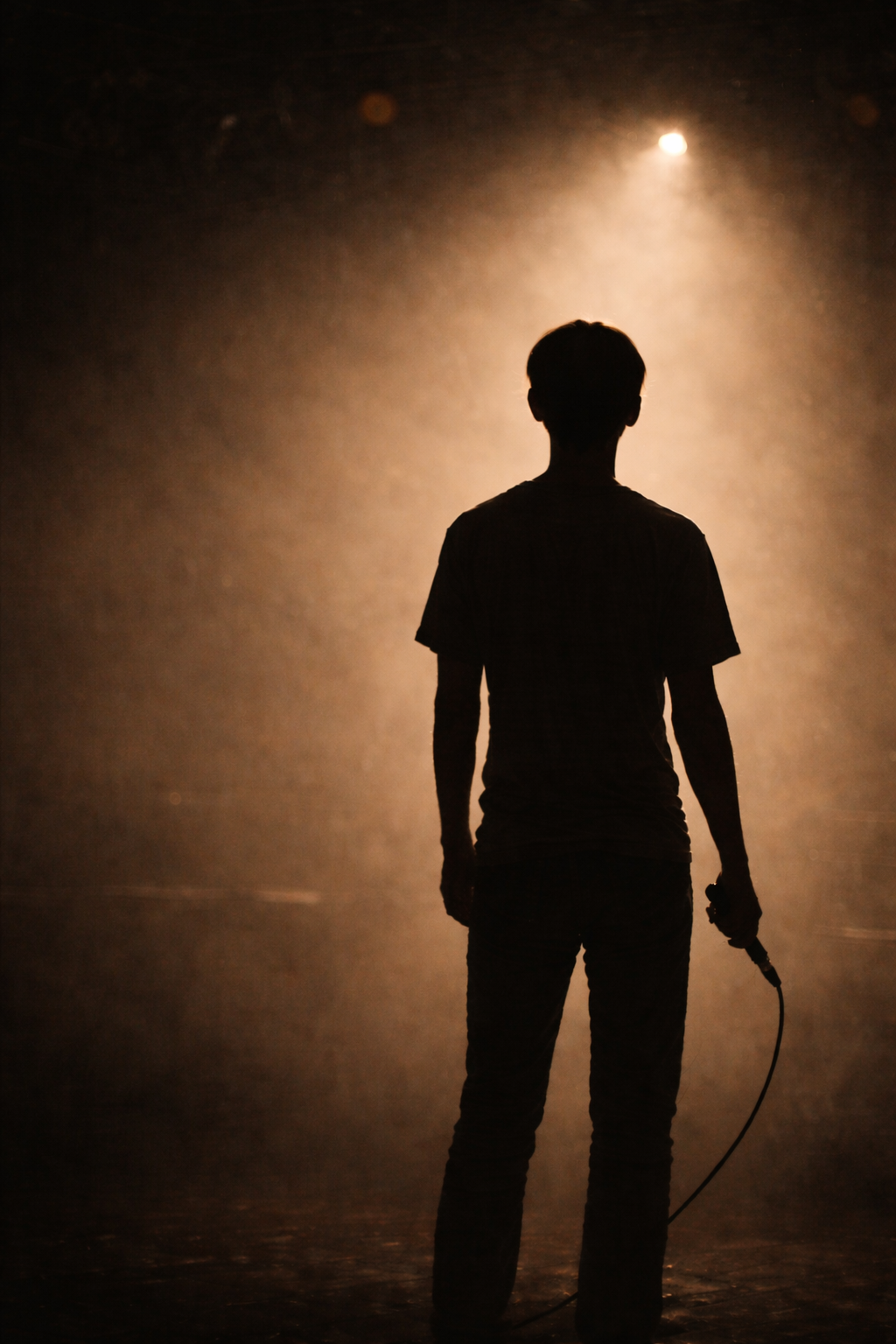
This poem was inspired by my experience of losing the vocal confidence that had long shaped my identity as a performer in theatre and choir, as well as social interactions. During 9th grade, I developed a vocal condition which made speaking and singing feel unstable and inauthentic, as I could only speak in a falsetto, whispery voice, forcing me to step away from theatre and from using my voice in ways that had once felt natural. That period of distance reshaped my relationship with performance, expression, and identity. This poem focuses on the theme that nothing we love—whether a voice, a passion, or a version of ourselves—remains unchanged or permanently ours. We sometimes must step away from what defines us in order to return with a deeper understanding of it. This poem includes elements from the musical Hadestown, which was the first show I did after returning to the stage, and its idea that songs are always sung again but never in exactly the same way. The poem reflects on change, distance, and the possibility of returning transformed rather than entirely restored.
At first it feels permanent,
the thing I loved,
the way certain sounds came easily,
the way my vocal folds vibrated
without being asked how.
I stood inside it without noticing
there are walls at all,
boundaries,
ends,
as if what held me
was built to last indefinitely,
as if it would remain,
as if it could remain,
as if anything remains.
I name this star that has already died,
lightyears away,
but gone nevertheless.
For a while, everything responds.
Breath arrives on time.
Notes settle where they should.
I move without telling myself to move,
the body a behaving like a prophecy.
It feels like an intrinsic characteristic,
a language before it is written,
gravity before Newton discovered it,
grounding my identity.
Then the distance begins,
quietly.
Nothing breaks cleanly.
There is no single moment
I can point to for its disappearance.
It merely dissipated
and faded away,
my identity a glacier that gradually shifted,
burying my character
underneath a sea of
undesired change and destabilization.
Left with only a growing awareness
that what once felt natural
has become an apparition of the past.
I start to notice the mechanism.
How breath enters,
how sound leaves,
how fragile the space is
between the two.
I listen to myself speak,
dissecting every aspect of my speech,
autopsying something feeble, yet still alive.
My hands begin to betray me first,
damp palms pressed against notebooks,
sleeves,
anything that will absorb the evidence
that I’m not normal.
Every room becomes an acoustic test.
I measure the volume of others
before deciding whether I exist.
When laughter rises too loudly
I hum just beneath audibility,
a private tuning no one must notice,
coaxing warmth into a reluctant instrument.
I pretend to listen
while preparing a voice
that may never be used.
In classrooms I learn the discipline of absence.
Insight gathers, fully formed,
then dissolves before reaching air.
I calculate the cost of speaking
and choose silence as economy.
Still, something rises and lodges.
A small, unspoken weight
pressing against the throat
each time I decide
it is safer not to be heard.
I begin to resent my voice
for requiring so much care,
for turning every word
into labor.
I step back gradually.
Not out of rejection.
Not even out of choice.
Like the tide pulling from shore
without asking permission.
For a while I believe
this is temporary,
That what waits for me
will wait unchanged.
But distance works on things.
Even on what feels essential.
When I return,
nothing is ruined.
Only rearranged.
The space still holds me,
but differently.
What once carried me
now asks to be carried.
What once felt effortless
has weight.
My voice has triumphed its own ending.
I move with awareness
of each small adjustment,
each careful placement
of breath and sound.
Everything has changed.
It feels easier to love
without the pressure
for it to feel the way it once did.
Without the illusion
that I must remain
who I was inside it.
I returned to it again,
a space with boundaries,
but capable of changing
without disappearing.
And standing there now,
inside what I once stepped away from,
I understood something
that only distance could teach:
Nothing you love
is meant to hold you forever.
You pass through it.
You leave.
You return.
Each time
something altered,
but each time
able to hold it
with less fear
of losing it again.
Everything worth loving
moves in cycles,
not permanence,
echoes that will ring again.
And as the spotlight strikes
my face,
a new voice emerges from the same mouth,
carrying the same spirit,
the same passion,
the same audience listening.
“We’re going to sing it again and again.”
The song survives by being sung.
Only now,
I refuse the old instinct
to turn back and search the dark
for what can no longer resound.
I face the light,
shed the old skin,
let the new voice rise,
and the echo follow.
Leave a Reply